A

Fragments of Børsen is a response to the reignited debate on cultural reconstruction following the fire at Børsen. Rooted in the field of graphic communication, the work examines how reconstruction can be approached as a practice of data visualisation—where meaning is shaped through data, representation, and technological mediation. The project culminates in three spatial and visual proposals, each engaging with different visual documentation of Børsen after the fire, to explore how absence, damage, and interpretation can become part of a visual understanding of the act of reconstruction.
Context
On 16 April 2024, Børsen caught fire, and within hours the iconic building’s silhouette partially collapsed. In the time that followed, the event sparked a widespread discussion, where politicians, professionals, and the general public engaged in a conversation about the significance of the building, what it represents, and whether or not it should be rebuilt. A year later, the event continues to resonate— embedded in the public consciousness as a shared moment of loss, reflection, and response.
Cultural reconstruction has long been discussed within architecture and conservation, and the debate invites curiosity about how the conversation around reconstruction might unfold when viewed through the lens of visual design—what kinds of perspectives could emerge, and which questions could be brought to the surface.
The field of Design and Graphic Communication is grounded in an exploration of how meaning is shaped through visual language—how tools, formats, and technologies influence expression, and how communication can function both analytically and critically in relation to cultural and societal contexts. This orientation opens space for design to engage with complex questions, challenge existing frameworks, and reframe how we relate to the conditions that surround us. From this perspective, the reconstruction of Børsen can become an entry point for exploring how cultural history is shaped through acts of visual and material translation.
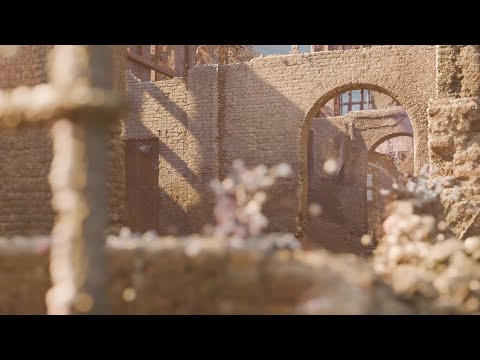
A Passage Through Data is a video installation that examines how the same dataset changes meaning and appearance depending on the environment it is visualised within. It consists of three synchronised screens, each presenting a separate animation based on the same point cloud data, rendered respectively in the 3D softwares Unreal Engine, Blender, and Autodesk Recap.
Each animation follows a similar path through the scanned structure, but illustrates different ways of encountering the point cloud — highlighting how tool and perspective influence what is perceived, understood, and formed. Herby the piece invites reflection on reconstruction as a shifting image, shaped not only with the data it draws on, but also by the tools and perspectives through which it is rendered.
The visuals are accompanied by a generative soundtrack, composed by translating the same point cloud data into MIDI sequences. Captured as numerical coordinates and colour information, the scan forms a flexible digital record — revealing how point clouds can unfold across different formats. As a structure of pure information, its potential extends beyond current applications, open to interpretations and technologies still to come.
From Points to Surface investigates the relationship between data, absence, and visual form through the use of photogrammetry. Based on available image documentation of Børsen, processed through the software Agisoft Metashape, three series of 3D printed objects are produced, each corresponding to the different stages in the photogrammetric process: point cloud, triangulated geometry, and the meshed surface.
This series explores how reconstruction emerges through the limitations and translations of visual data. Each step makes visible where data is present and where it is absent—areas with dense photographic coverage yield more defined shapes, while missing information leads to gaps, smoothing, or speculative surfaces shaped by interpretation. By following these stages, the piece reveals how reconstruction is not a fixed replication, but a layered visual negotiation shaped by software, resolution, and input.


Reconstructed What Remained centres on three sandstone figures embedded in Børsen’s facade. Using depth maps generated from single images, the figures are reinterpreted as physical models casted in plaster, drawing inspiration from a traditional technique used by stonemasons in preservation and restoration work. The material transformation, from image to volume, highlights how fragmented visual data can be extended, interpreted, and translated through technological processes.
While traditional restoration involves reconstructing damaged elements to a complete and intact state, this piece explores the possibility of preserving the condition in which the figures were photographed—creating new artefacts that translate their damaged appearance into spatial presence. In doing so, the series reflects on how the ruin might persist as form—how absence can be held visually and materially. As such, the piece becomes an investigation into visual translation: how damaged fragments become spatial objects, how tools actively shape their expression, and how reconstruction might involve preserving loss, rather than correcting it.


This exploration positions reconstruction as a critical spatial practice—one that operates between disciplines, and between modes of seeing, making, and interpreting. Drawing from the tools and methods of visual design, the project unfolds a proposition: a way of engaging with loss that remains open to complexity, contradiction, and interpretation. However, this project does not claim to offer a singular or definitive response. Its proposals reflect one situated approach among many possible framings of a complex cultural question. The work invites dialogue, rather than resolution—foregrounding design as a way to think with uncertainty, and to contribute critically to the broader conversation on reconstruction.
As the project moves into its final phase, the exhibition becomes a site of encounter—where data, absence, and visual strategy are brought into form. In bringing together layered processes and varied technologies, the work highlights how meaning is not recovered, but continually produced through acts of selection, framing, and transformation. In doing so, the project gestures towards new ways of framing the reconstruction of Børsen—as an ongoing negotiation between past and present, between what remains and what might be reimagined.