A


A descending journey into the deep concrete tunnels of the Ilissos River in Athens, the project partakes in the irrationality of the depth. It attempts to voice the humidity, the acoustics and slow performativity of the river reshaping the underground. A method for engaging with subterranean lakes, eroded walls and ecologies in the dark. A call to speleology in the topography of the underworld.
The thesis investigates the river Ilissos in Athens, Greece, covered in 1933 and now invisible in the urban landscape. It examines the practice of tunnelling, channelling, and otherwise controlling dynamic rivers through static infrastructure, traditionally a common response to the unpredictability of rivers in urban contexts. The paradox being the attempt at control, that often renders cities even more vulnerable to changing climates. Changes which today threatens Athens with increased floods, heat islands, and depleting water reservoirs.
The proposal is a call to speleology as a method for sensing subterranean forces and perceiving the continued agency of the Ilissos. Through bodily submersion, it develops a speculative proposal for a karstic nature reserve, reimagining the river's role within the karst landscape, a porous mountain structures where water has eroded limestone, to form vast underground networks of waterways, deposits and subterranean ecosystems. The project focuses on a section of the river at Aghia Photini, an area where the river once ran freely, but today has left a dry riverbed and a remnant of a landscape that once was.
[SPELEOLOGY]: the study and exploration of caves, karst landscapes, and underground environments. Combines geology, hydrology, biology, and archaeology to understand cave formation and related ecosystems,
I would also like to express a sincere thanks to my supervisor, Guro Sollid, who has been an important and constant support in shaping this thesis project. Thanks also to workshop supervisors Mikael Jackson and Esben Kaldahl, whose material knowledge and craft have been essential in the processes of creating the representational models for the thesis.
[THE NOSE OF ILISSOS]: A connection of two different typologies of the tunnel where the river Ilissos runs today. Visited in Dec. 2025.

In one of Dostoevsky's cryptic novels, Notes from Underground, or in Danish: Kældermennesket (the basement-being), the story is one of a duality between the physical underground and an inner sentimental one. The story ends with the protagonist denouncing the mechanical and superficial nature of his contemporaries and questioning whether our society knows what life is or if we just indulge in the illusion of it.
The novel is a complex product of its time. The nineteenth century was marked by rapid urbanization and industrialization, which reshaped infrastructural practice and caused a paradigm shift toward hygiene and controlled environments. Infrastructure became a superficial tool in the sense that it established the conditions for our prolonged presence within a space, a means of colonizing the land and nature upon which our cities and societies still rest.
[AN ECOHYDROLOGICAL RELAY]: A model of three connected parts operating within an electrical relay, programmed to artificially sustain the biological processes of algae and mycelium. The model is subject to slow degradation by the very biological processes it seeks to control.


The model is an interconnected system representing the ecohydrological field of the Ilissos, built from a glass amphora, particle filter, live mycelium, live cyanobacteria from the Ilissos, a beeswax oil lamp referencing Athens, a dark-tinted glass fusing depicting the Titanomachy, and an electrical relay. Together these form a network linking the biological processes with the cultural references, drawing on Anna Tsing's concept of feral ecologies, where biological processes persist alongside and through constructed systems.
The relay is the centerpiece: housed in a 3D-scanned Titanomachy relief form reworked from fieldwork, it controls power to the mechanisms sustaining cyanobacterial and mycelial growth, and stands as a commentary on infrastructure's attempt to render dynamic biological processes static. The model is "alive" in that it erodes, decays, and fails, simplifying the Ilissos's ecohydrology while exposing the fragility of any attempt at controlled replication.
A fascination for the epistemological origin behind ancient myths and the commonality of covering rivers through urban infrastructure brought me on a fieldwork trip for two months to The Danish Institute at Athens, to seek out the Ilissos river and shed light into dark tunnels as its river path flows beneath the city today. Within deep tunnels of massive acoustics, deep moisture, old cooling winds, and subterranean lakes sculpted with unknown life, I followed the contemporary river path and experienced the continual agency of a river urbanely forgotten.
The great illusion of infrastructure is its apparent stability: once in place, it seems to regulate, control, and stabilize otherwise dynamic systems, creating a predictable ground. Yet the buried Ilissos demonstrates the limits of this control. Out of sight, the river continues to act, eroding, forming lakes, and undermining parts of the city of Athens. It acts with an agency, interacting with the organisms in its waters and in the soil beneath. A vibrant matter beneath the thin membrane of stone, asphalt, and concrete upon which our daily rhythms unfold.
[THE TUNNEL ENCLOSURE OF ILISSOS]: A 1:100 representation of the Ilissos tunnel as it stretches beneath Athens today, capturing the intermediate connection between the tunnel's typology of 1933 and the later 1942 section around the "Nose of Ilissos", an almost anthropomorphic room in character. The representation is based on a survey through the service tunnel and measurements taken from below. The model is made in solid aluminium, to materially engage with the continual erosion and new topography formed under the river's agency in the dark.


The Tunnel reconstructs a section of the Ilissos near the Panathenaic Stadium in Athens, reached through a narrow service tunnel that leads to a meeting of two tunnel typologies, where the "nose of Ilissos” appears in a deep, cave-like room.
Cast in solid aluminium at 1:100 scale from measurements and 3D scans taken during fieldwork in December 2025, the model weighs 6.5 kg and serves as a portal, a representation of the experience of descending into the tunnel chambers underground.
Its typology is foreign to conventional architectural space, carrying an almost anthropomorphic quality: a barathrum, a chasm, describing the descent through eroded passages where spatial conditions alter the perception of boundaries and make the idea of a surface less immediate.
Topography of the Underworld is a title implying a duality of space, the current feral agency of the river shaping a new topography of the underground beneath Athens. The project proposes the body as a method for engaging with the complexity of the river, within and affected by the space, to transcend an under-world dimension: an inner reflection as we temporarily become part of the deep subterranean forces and perhaps rethink the role of our infrastructure, and co-exist with the waterbody and ground, essentially challenging the perception of an over/underground polarity.
As the thesis interacts with the Ilissos, the most culturally referenced river in Attika, from the Parthenon statues, Plato's Phaedrus, to countless romantic imagery of a past Athens, it crosses with the importance of ecohydrology and a study of the porous karst landscape upon which Attika rests: the effect of human-made infrastructure on a complex ecology spanning mountain origin and river mouth, while being linked to countless other-than-human processes. What does it mean to seek out the tunnelled Ilissos as a speculative, active participant in the landscape, shaping it dynamically and conveying the importance of microbial, bacterial, and fungal life entangled in soil and water?
[THE KARST LANDSCAPE]: A representation of the geological subterranean processes that have shaped complex networks of caves and conduits beneath the surface. The model is made from clay fired with a raku glaze, mimicking the geological formations and surfaces experienced when descending into karst caves and following underground waterways. The model is approximately 1100 x 300 x 250 mm.


The ceramic representations attempts to mimic the slow geological processes by which limestone and dolomite dissolve into caves and conduits, recreating the spatial structure and phenomenology of subterranean caverns. The model resembles the karst landscape as if the topsoil were lifted away to reveal the caves within the dolomite.
Fired over three hours in alternating intervals of heating and pause, then violently submerged in sawdust to create combustion and oxygen reduction. Finally cooled for hours; the object can then be unearthed, bathed and polished to reveal its karstic resemblance. The result is a roughly 1000 × 300 × 250 mm speculative karst landscape, reflecting how the tunnelling of the Ilissos has altered Attica's ecohydrology by redirecting its water.
Though fired and dried, the caves persist underground, largely unknown to those above, the dark raku-fired clay conveying a phenomenology of hidden subterranean space.
Within this thesis, the basement-being returns within a new light: an inner dialogue prompted by physical descent. We can ask ourselves the same question as in Dostoevsky's novel, and reflecting on basements, we are invited to dream with subterranean forces, imagining bodies as instruments for engaging with agent rivers. To descend is to explore what it would mean to place this logic first, to think in terms of a dynamic river and its unpredictable, living landscape.
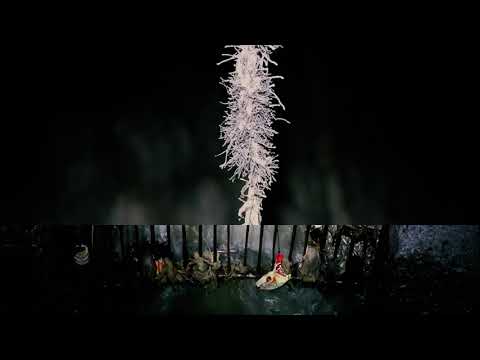
[KATABASIS]: A Greek term that literally means "a going down" or "descend". Most commonly, it refers to a mythical, religious, or psychological journey into the underworld or realm of the dead. The film is an entanglement of scenes from fieldwork in Athens in December 2025, paired with a journey downwards. It sets the scene of the topography of the underworld.
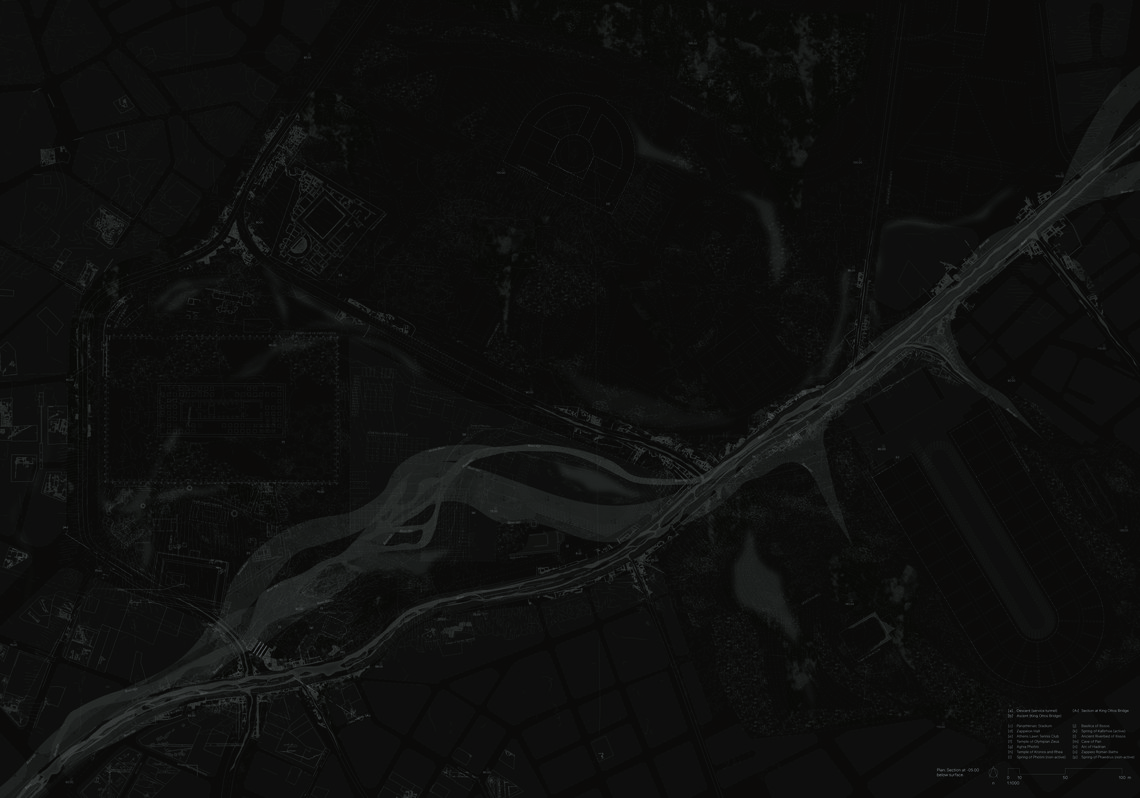
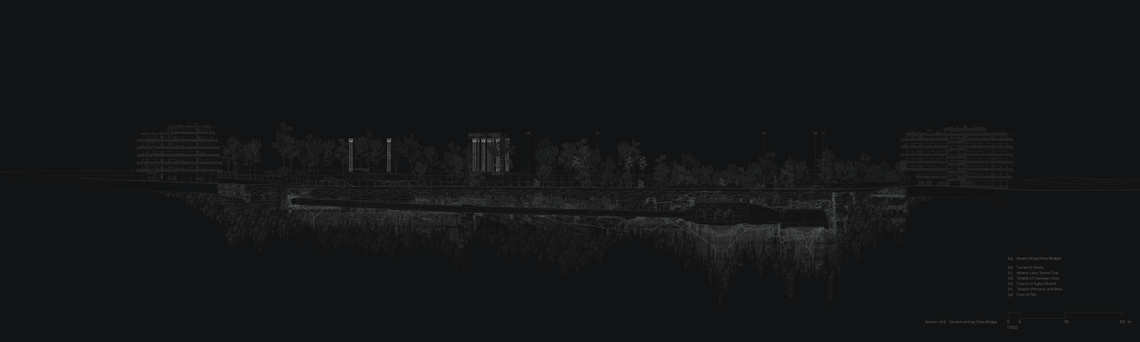
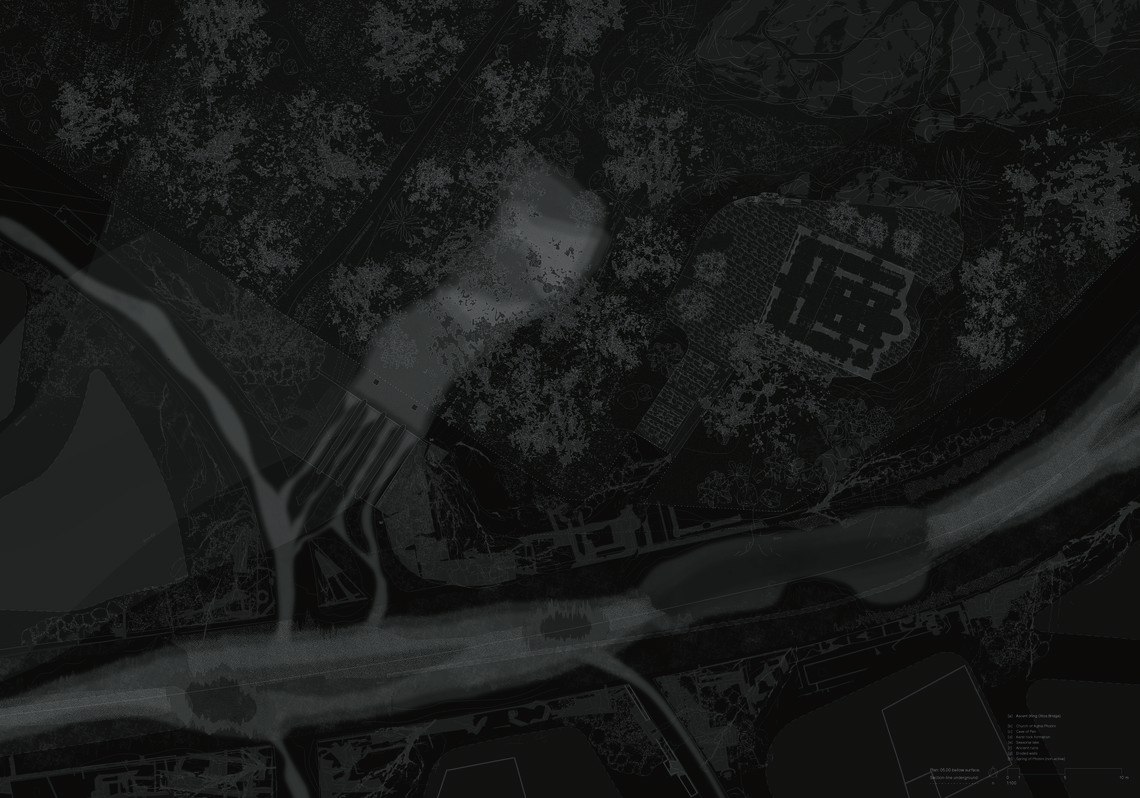
The following drawings and sections explore Aghia Photini, an area in Athens where the Ilissos river once ran but has since been enclosed underground. What remains is a residual landscape where natural and cultural histories, a dry riverbed, a Byzantine church, karst springs, ancient temples, continue to overlap and entangle.

Mapping the river as it flows underneath Athens. Section around Aghia Photini, Panathenaic Stadium, Zappeion and Olympieion.


Aghia Photini a Byzantine church from the 19th century, built on the site of former churches at the same spot. It stands within the characteristic landscape of the Kallirhoe Spring, which forms due to the presence of karstic rock and a deposit where the Ilissos once openly passed. The spring is now dry and the old riverbed of the Ilissos remains, yet the now the river runs underground. The church stands in a leftover space, without any clear programme, yet here remains the experience of a landscape that once was. The area of Aghia Photini is rich in cultural and biological references, from the Pan Cave and karst rocks to numerous temples and the Olympieion.
Athens once had three rivers, which ran through Attika: Kephissos, Eridanos, and Ilissos. They were seasonal in the sense that they carried significant amounts of water at certain times before nearly disappearing again. Kephissos was the largest of the rivers, bringing water from the surrounding mountains to the north, while Ilissos primarily collected water from the southern Mount Hymettus. Eridanos, the smallest of the three, ran through the city near Kerameikos and is today the only one of the rivers that is partially visible, following excavations during the metro construction in the area.
Around 1941, the last visible parts of Ilissos were covered over. The river thus physically disappeared from the urban landscape, marking the transition to a new epoch in Athens's history, which truly took shape during the 1960s.
Among the last traces of Ilissos, a former riverbed was left behind as a residual landscape in the city. The area was placed under protection and remains visible today, but lacks any real long-term plan for its use. This is the focus area of the thesis, as both cultural and natural references are intertwined and the story of the Ilissos, can be told from the landscape at Aghia Photini and below.


[AN UNDERWORLD DIMENSION]: Taking inspiration from the epistemological origins of mythological tales, where a descend into the underworld was a way of understanding through transcendence, contemplation, and enlightenment, this project draws on the idea that we might descend into deep caverns, into a dimension of the under-world and to learn something new about the life above. In doing so, it seeks to erase the hard frontier of the surface. These diagrams aim to couple biological and geological processes with the act of submerging oneself into the depths, drawing on cultural references to evoke a state of reflection within the under-world.


What’s the name, what’s the name
of the river?
Ilissos, Ilissos.
I am going to tell you my little secret.
I love you, I love you.
Babies cry for their mother,
but I am a lonely orphan.
Birds fly with their feathers,
but I am flying into the dance.
What’s the name, what’s the name
of the river?
Ilissos, Ilissos.
I am going to tell you my little secret.
I love you, I love you.
Manos Hadjidakis - Ilissos Ιλισός