


A
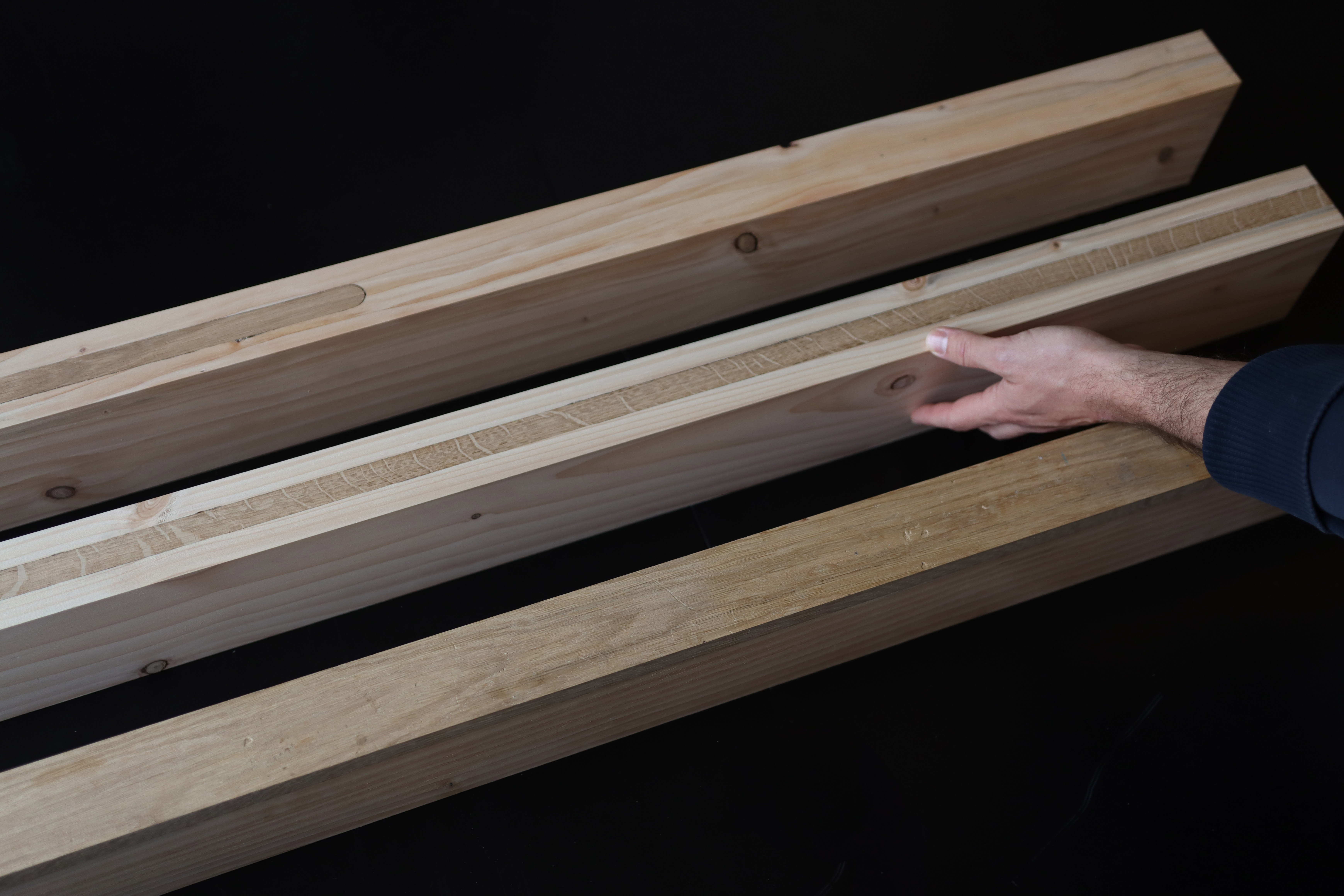
Investigations focused on heat transfer combine low- and high-density species with varied fibre direction and geometric assembly variations to explore the potential of modulating heat movement in wood structures. The experiments examine specifically how heat transfer can be increased to steer cooling of structures, and decreased to improve heat retention of buildings.
The resulting hybrids produce architectures that are functionally and expressively articulated at the same time.
The studies are based on 1) material studies of the individual species through thermal imaging and heat transfer measurements, 2) prototyping experiments to explore possible assembly methods, adhesives, geometric relations and fabrication methods, 3) thermal heat transfer simulations of complex assemblies and 4) field studies with prototypes exposed to environmental conditions, evaluated through qualitative material observations and heat transmission measurements.


The investigation specifically examine the mechanical properties of pure grand fir specimens and hybrid grand fir and reclaimed oak specimens in both clear wood and structural scales.
Related publications:
Ruan, G., & Foged, I. W. (2026). Hybrid wood species design for structural elements: experimental investigations at two scales. Construction and Building Materials. [Link]
The hybrid wood species samples are tested in small clear wood scale, where different failure modes are observed. The failure modes indicate the hybrid effects of different hybrid types, which can be applied for structural scale exploration.
The hybrid wood species design is also tested in structural scale, where hybrid beam elements are destructively tested. The results are validated by an analytical model developed from the small scale test results.
The structural potential of hybrid wood species design is explored through a pavilion demonstration.
Related publications:
Ruan, G., & Foged, I. W. (2026). Wood Hybrids: multi-species spatial timber structures. IASS Annual Symposium 2026, Turin, Italy. [Link]
The joint developed in Wood Hybrid pavilion uses reclaimed hardwood as the main load transfer component. Through a layered arrangement, the hardwood is connected to both horizontal and vertical elements through dowelled connections.


