A

Presence of the ordinary: What does it mean to truly value the objects we use every day? Imagine a bowl that accompanied your childhood—a vessel for soup, cereal, or ice cream. Over time, it disappears, but the memory of it lingers.
Why does the loss of such a simple object carry emotional weight?
This project explores that question through the lens of ceramics and the everyday ritual of the set table. Centred on functional ceramic objects—jugs, bowls, plates—this work investigates how craft shapes our experiences around food, memory, and connection.
The set table becomes a site of inquiry: a daily, shared space where objects are not only used but also felt, remembered, and passed on. Drawing from both historical and contemporary references—from the opulence of the Baroque to the restrained beauty of Scandinavian craft—this project examines how material, form, and function converge. Inspired by thinkers such as Glenn Adamson and Soetsu Yanagi, it reflects on the role of handmade objects in a culture often driven by speed and disposability.
As both a maker and observer, I position myself within this dialogue—creating ceramics that invite not just use, but conversation, reflection, and the subtle storytelling of everyday life.

“We must not forget to cherish freedom within our homes, to not abstain from pieces just because they could jeopardise our aesthetic formalism. It is never a fabricated colour chart that gives a home its personality, but it is all the things one collects through life. All the things we once loved, alongside all the things we love today. — our homes are never completed, during our entire lives, we continue to build upon them.”
— Estrid Ericsons in “The Catechism of Interior design “, 1939. (Svenskt Tenn, n.d.)
As Estrid Ericson says, the set table, no matter where in the world, carries a kind of universality. It is a place of gathering, of ritual, of sharing. Whether we eat alone or in company, we still gather around food and memory. Around presence. And that is what I hope my work brings—a quiet reminder to pay attention, to hold on, and to value the everyday as something extraordinary.


There is a Japanese term: mingei—meaning “the crafts of the people.” Created just over a century ago by philosopher Soetsu Yanagi, together with potters Hamada Shoji and Kawai Kanjiro (Perry, 2024), it arose as a response to the growing industrialization of everyday objects. Mingei was not only about preserving handmade beauty but about recognising the quiet dignity and deep cultural value in ordinary, anonymous craftsmanship.
In a world where things are made to be replaced, I find meaning in the handmade. Not because it's rare, but because it invites us to slow down. To notice. To care. Every piece I make is a chance to connect—to others, to a moment, to the material itself.
The pieces I have created—jugs, bowls, and plates—are my interpretation of the shared elements on the table. They speak not just to utility, but to presence. They explore contrasts in material and form, the interplay between porcelain and stoneware, softness and sharpness, and the subtle rhythms of use and touch. I was guided by questions: How do we connect with the objects we use every day? What do they reveal about who we are, where we come from, and what we value? And how does that influence the look of a set table today?
Working with tableware has also prompted reflection on how we value our everyday objects. If a piece chips, do we discard it? Or do we keep using it, honouring its history? I believe we do—and should. A handmade object becomes part of our lives. It asks to be cared for, not just used. As Glenn Adamson notes, we’ve lost some of our connection to humanity —but I believe we’re trying to find our way back. The growing interest in ceramics and craft speaks to that desire. People want to surround themselves with things that are not only functional but also beautiful, meaningful, and made with care. I have a friend, an artist, who said that if his work could resonate with one person, that was enough. At first, I didn’t understand—but now I do. If someone can connect with one of my bowls, if it brings them even a small moment of joy or reflection, then that object has done its work. Those pieces hold fragments of life. That’s where I come alive as a maker: in the relationship between object, process, and memory.


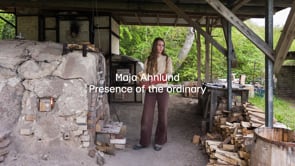
In choosing to wood fire the final works, I embraced unpredictability, imperfection, and time. These qualities reflect my view of both life and ceramics: that the most meaningful things are often the ones that resist control and invite openness. Like the shared table, they are shaped by both intention and accident, by presence and participation.
The attention required for a firing sharpens your senses and you become increasingly aware of subtle changes in your surroundings, bringing you more in line with the present and the time that it takes. From the moment that you light the fire, that is your sole focus until the pots are ready, and it is time to seal the kiln.
The woodfired look is raw and it creates this meet with the clay that you can´t predict. Which for me is the beauty with this type of firing.